March 27, 2008

Announcing the Dynon Avionics Autopilot

Announcing the Dynon Avionics Autopilot

March 27, 2008
You've probably heard the rumors over the last few months. More recently, you may have seen the ad in the latest issues of Kitplanes, Sport Aviation, and Sport Pilot magazines. Well, we're ready to start talking: The Dynon Avionics Autopilot is almost here. You can see it in action at Sun 'n Fun.
Think of it as the only autopilot that comes with a COMPLETE set of primary flight instruments for free. Alternatively, an EFIS can become an autopilot for the incremental cost of servos ($750 each). Adding servos to any Dynon EFIS or FlightDEK turns it into a full-featured dual-axis autopilot at a total cost that is comparable to other autopilot-only solutions.
Every Dynon autopilot can fly magnetic heading, GPS ground track, and horizontal NAV from any connected radio or GPS. In addition to being able to hold altitude, even the least expensive Dynon autopilot can fly to a new altitude and level off once it arrives. Additional standard features include emergency 180-degree turn capability and control wheel steering. And because Dynon’s autopilot is built on its best-selling EFIS systems, it can respect bank angle, airspeed, and G limitations too.
The optional AP74 Dedicated Autopilot Interface Module ($450) adds separate autopilot controls and status for a superior user interface. It also adds the ability to pre-arm which mode will be flown upon autopilot engagement. Stepping up to the AP76 Advanced Autopilot Module ($1500 - coming late 2008) adds the modes you’ll want when flying IFR. This means fully coupled approaches – both horizontally and vertically – when connected to a capable NAV radio or GPS. Other modes exclusive to the AP76 include vertical speed, altitude/heading/track/vertical speed pre-select, and other features formerly only found on much more expensive autopilots.
If you are seeking a redundant solution, consider this: our products are priced so well that two EFISs, one of which is a two-axis autopilot, start at just $5900 with servos. Compare that to the cost of outfitting your aircraft with just a single set of flight instruments and an autopilot from anyone else.
Installation kits for popular aircraft will be attractively priced. Initially we will have kits for the Vans RV series, with more to follow.
Dynon Avionics anticipates shipping its autopilot products beginning Summer 2008. As we are still working through a robust test program, exact release dates are still to be determined. Also note that we expect to satisfy initial demand for the autopilot.

Servos - $750 Each

Dynon Avionics servos are dimensionally identical to other leading servos for drop-in upgradability. Behind the scenes, though, the SV line of servos are all-new. A lightweight aluminum case houses a stainless steel gear train to optimize weight while not sacrificing strength. The servo control arm is captured by a castellated nut and secured by a cotter pin, just like other critical interfaces in your aircraft. Each servo is managed by its own microprocessor, making the servo an active, smart extension of the autopilot. This simplifies the control-surface-to-servo calibration, and prevents the servo from driving itself endlessly like other servos can. As an ultimate mechanical failsafe, a simple and effective shear pin is employed to let you break the servo free of the aircraft control surface in an emergency.
Multiple servos will be available to suit different aircraft control forces. The SV32 is rated at 30 in lb of torque, the SV42 at 40 in lb, and the SV52 at 50 in lb. Servos with capstan drives will also be available. Not all will be available at initial release.

AP74 Dedicated Autopilot Interface Module - $450

The AP74 Dedicated Autopilot Interface Module adds panel-mounted controls and LED status lights to your autopilot. While it does not add additional modes to the EFIS's built-in autopilot, it allows you to choose (pre-arm) which of magnetic heading hold, track hold, NAV mode, and altitude hold will be engaged when you turn on the autopilot.
The AP74 is mechanically identical to the HS34 HSI expansion module, and the installation instructions already provided in all EFIS installation guides available here can be used as a general guide.

AP76 Advanced Autopilot Module - $1500 - Available late 2008 (Project on hold)

The AP76 Advanced Autopilot Module adds panel-mounted controls, LED status lights, and a number of advanced modes to your autopilot. Vertical speed hold can be used on its own or in combination with an altitude target. Vertical NAV mode, based on either GPS or NAV radio data, adds the ability to fly fully coupled approaches. Additionally, all modes that have selectable targets – including altitude, heading, track, and vertical speed – let you to pre-select target values before you engage the autopilot. This allows pilots to fully pre-configure the autopilot in advance of engaging it in IFR and other complex scenarios.
The AP76 is mechanically identical to the HS34 HSI expansion module, and the installation instructions already provided in all EFIS installation guides available here can be used as a general guide.

Additional Information and Features

The Dynon Avionics Panel Planner now has actual size cutouts of the AP47, AP76, and the previously released HS34. Pick one up in person at Sun 'n Fun.
View the answers to frequently asked questions about the autopilot.

November 1, 2007

EDC-D10A remote magnetometer service bulletin

EDC-D10A remote magnetometer service bulletin

Date: November 1, 2007

Problem and Affected Units

An underperforming component (a diode) used in some EDC-D10A remote magnetometers causes "type 2" OATs to erroneously report higher OAT than is actually being experienced by the probe.
This problem does not affect all EDC-D10A units; but of those it does, the issue exists in two different forms depending on manufacture date. One form is more pronounced than the other. In both cases, OAT will be reported higher than actual at lower temperatures.
Because temperature is erroneously reported higher than it should be, the one possible safety concern that could arise from an incorrect OAT reading is eliminated. If you are relying on your EFIS's OAT-based density altitude calculation, it will be computed as a higher altitude than correct when the OAT is reporting a high temperature. If you are further using that density altitude calculations to compute runway requirements, you will end up with a longer computed runway requirement. Though of course not optimal, this will not compromise safety by allowing you to think you can take off from a shorter runway than you really can.

Units NOT AFFECTED

This problem IS NOT FOUND in older EDC-D10 remote magnetometers (note the missing trailing "A") which are hooked up to the original EFIS-D10.
This problem IS NOT FOUND in EDC-D10A remote magnetometers with a serial number higher than 7779. This corresponds to units shipped on or after 10/15/2007.
It is not believed that this problem exists on any EDC-D10A units with a serial number lower than approximately 3300, or units that were shipped from Dynon Avionics before February 2005. A positive way of identifying whether your unit has this problem is described below.
Though your EDC-D10A may have the bad component, this problem WILL NOT AFFECT you if you do not have a "type 2" OAT hooked up to your EDC-D10A. This OAT is sold under part number 100433-001. It is identifiable by a small piece of black heat shrink tubing around the wires near the sensor end of the probe.

Affected Units and Symptom Characterization

EDC-D10A units sold between approximately February 2005 and April 2007, with serial numbers between approximately 3300 and 6700:
  • Below -10 degrees Fahrenheit, the OAT displayed will be higher than the actual OAT.
EDC-D10A units sold between approximately April 2007 and October 15, 2007, with serial numbers between approximately 6700 and 7779:
  • Below 40 degrees Fahrenheit, the OAT displayed will be higher than the actual OAT.
Note that in both of the above cases, the displayed temperature WILL continue to decrease, albeit incorrectly, as the actual OAT decreases.
If your EDC-D10A is in either of the above ranges, but has a "D3" marking (either labeled or handwritten), your EDC-D10A has already been fixed and needs no further work.

Additional Verification that your EDC-D10A is Affected

In addition to verifying via comparison with the serial number ranges above, you may open your EDC-D10A to authoritatively check whether or not your magnetometer is among those affected. This action will not void your warranty. You may also choose to send your unit in based solely on the serial number checks described above.
The EDC-D10A can be opened by removing the four brass screws on the sides of the shell. The cover of the EDC-D10A with the serial number can then be removed by lifting it straight up.
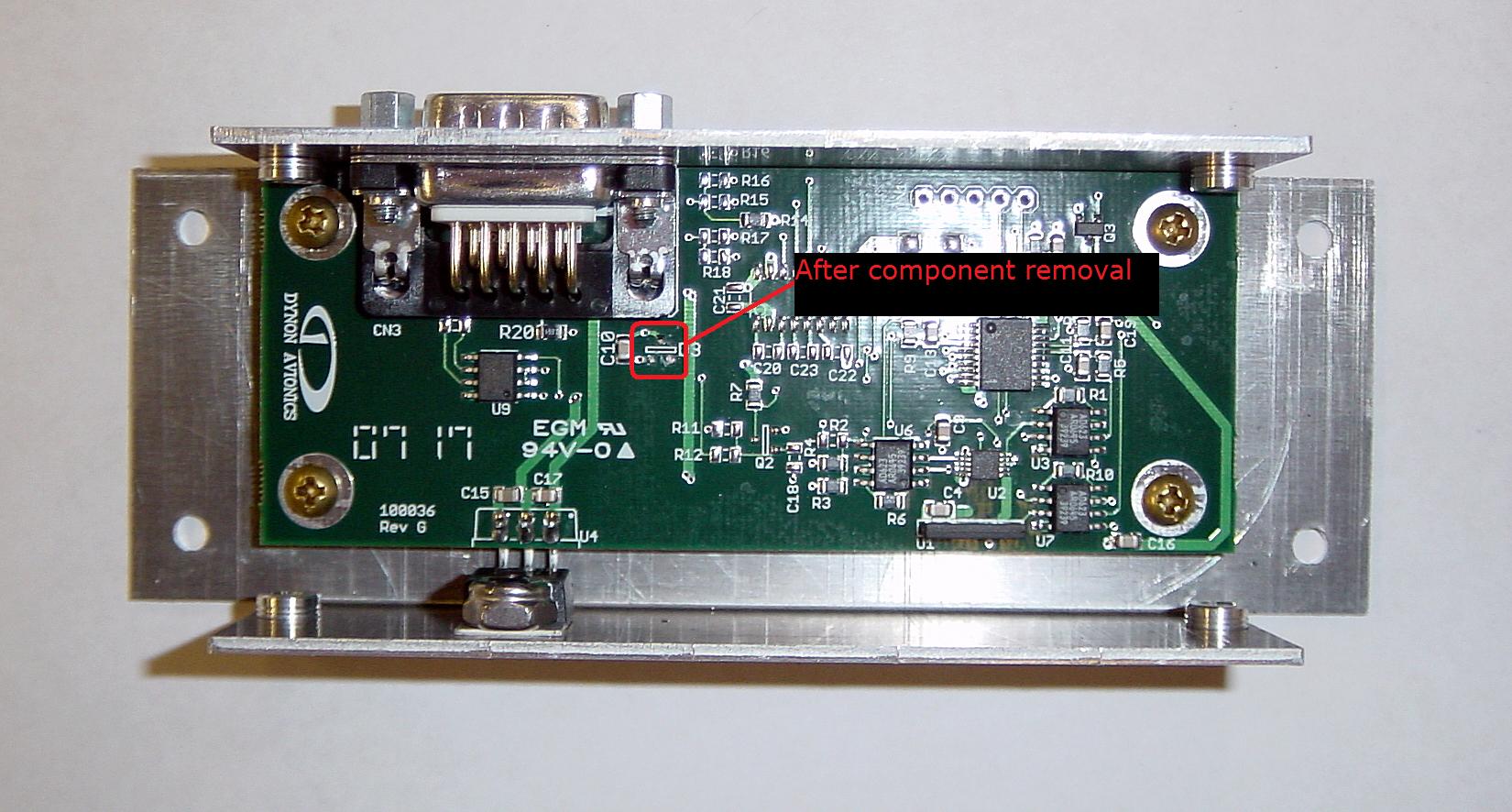
Once open, look for the small black component in the picture below. If that component is there, it needs to be removed, either by you or by Dynon Avionics. If the space is blank, your EDC-D10A does not suffer from this problem. Also note that your circuit board color may vary. The presence of this component is the sole definitive indicator of whether or not your unit is affected.
EDC-D10A with bad component - click picture for expanded view

Solutions

There are two ways to solve this issue.
If you own an EMS product or a FlightDEK-D180, you can move your 3 wire type 2 OAT from your EDC, to a spare EMS GP input as described in the installation manual.
Alternately, you can fix your EDC-D10A, either yourself or by sending it to Dynon Avionics as described below.

Fixing your EDC-D10A

If your EDC-D10A is affected as above, you have two options.

Option 1: Return your EDC-D10A to Dynon Avionics:

Unlike other support issues, we do not require return authorization for this problem. Simply send your affected EDC-D10A to
Dynon Avionics
19825 141st Pl NE
Woodinville, WA 98072
Clearly label the package you send with the words "EDC RECALL"
Enclose a letter with your return shipping address. Dynon Avionics will cover the cost of shipping your EDC-D10A back to you.

Option 2: Fix it Yourself:

You may elect to try to fix this issue yourself, per the instructions below. This action will not void your warranty, and it is exactly the same fix as we perform here if you elect to send it in. If you inadvertently damage your EDC-D10A while trying to fix it, you may send it in per the above instructions and Dynon Avionics will still fix it under warranty.
The component highlighted in the picture below is the one to be removed. Fortunately, it is not needed for correct operation of the EDC-D10A or OAT.
Before beginning work on your EDC-D10A, make sure you take the appropriate steps to eliminate damage from ESD (electrostatic discharge). The easiest way to do this is to make sure you have continuous contact with the EDC-D10A's chassis. Additionally, make sure you touch the chassis before anything on the circuit board. For more detail about taking precautions against ESD, see this article.
The easiest way to remove the component is to use a pair of precision wire cutters or dikes to cut it out. Desoldering the component is acceptable as well, but is harder to do on such a small scale.
Instead of trying to clip the leads directly, we have found it easier to start by cutting right down the middle of the black center portion of the diode itself. After it has shattered, use the cutters to clean up the area so that there are no remnant of the component remaining. In particular, there should be no remaining protrusions or leads that should be able to touch each other. The area should be essentially bare when you are finished. Clear out any remaining debris and ensure that all remnants are outside of the enclosure.
After you've removed the component and have the EDC-D10A put back together, please clearly mark the EDC-D10A with the label "D3". This will let any future owner of your EDC-D10A know that it has been fixed.
EDC-D10A with malfunctioning component - click picture for expanded view
EDC-D10A after malfunctioning component is removed - click picture for expanded view

October 15, 2007

Fall 2007 - Firmware 4.0 Update Available

Fall 2007 - Firmware 4.0 Update Available

October 15, 2007
Dynon Avionics is pleased to announce the availability of Dynon Support Program version 4.0. As always, this release includes the latest firmware updates for the entire Dynon Avionics product line.
Key features in this update include support for the new HS34 HSI expansion module and the long-awaited full version of the Dynon Smart Avionics Bus (DSAB). When loaded with 4.0 firmware, all communications between Dynon Avionics products are handled by the single pair of DSAB wires.
Additional fixes and changes are detailed in the release note links on the following page.

HS34 Now Shipping - October 2007

HS34 Now Shipping

October 15, 2007
Dynon Avionics' highly anticipated HS34 HSI expansion module has been released to production, with shipment of units on order beginning immediately! Dynon expects to be able to satisfy almost all initial pre-orders immediately.
The HS34 HSI expansion module provides ARINC-429, serial, and analog nav interfaces to enable full HSI functionality when connected to advanced navigation devices such as the Garmin 430/430W series. 

September 28, 2007

HS34 Status Update - September 2007

HS34 Status Update

Sept 28, 2007

While we won’t quite make a September release of the HS34 HSI expansion module and its accompanying 4.0 firmware release, we are getting very close. We are weeks away, not months, but do not have a firm release day available just yet. A team of testers is exhaustively flight testing to ensure that quality of these releases meet the highest Dynon standards. Thanks for your patience while we apply the final polish.

Capacitance-to-Voltage Converters now shipping!

Capacitance-to-Voltage Converters now shipping!

Sept 28, 2007

Dynon Avionics is pleased to announce the availability of fuel quantity Capacitance to Voltage Converters. These converters allow Vans RV builders with capacitive plates in their fuel tanks to measure fuel quantity with Dynon’s EMS products. One is required per tank; a maximum of two are supported in a system. Pricing is $50 each; part number 100654-000.
cap2volt

September 13, 2007

Manufacturing Triples Capacity

Manufacturing Triples Capacity – Stock now on Shelf!

Sept 13, 2007

Dynon is pleased to announce that its backlog situation in 2007 is now greatly improved due to a tripling of its production capacity. Dynon now has all of its products available either from the shelf or within a few business days. The long lead times that came about quite unexpectedly in 2007 and stretched out to 12 weeks are now gone. Dynon will continue to press forward in production and not let up until it has one month reserves of all items on the shelf.
A growing backlog situation started at the end of December when a large storm brought down power lines. Demand continued to grow steadily in 2007 and so did the backlog.
In response, Dynon began a large scale expansion program that impacted all aspects of its manufacturing process. In addition to doubling the number of manufacturing personnel and training them, it also widened and strengthened its supply chain network. To accommodate the additional workers, Dynon tripled its factory floor space which allowed it to form optimized production lines, handle all the work in process and house the larger volume of product streaming in from suppliers. Another key element included designing new procedures and processes that increased the throughput of Dynon’s automated EFIS calibration chambers.
While implementation took longer than originally hoped for, the net results of tripling the production capacity as well as strengthening its supply chain have positioned Dynon for future growth. “We are very excited about what the manufacturing team has accomplished this year as it not only reinstates our reputation for rapid order fulfillment but also better positions us for new products we’ll be introducing in the near future,” claims Ron Ulbrich, Dynon’s Marketing Director.